Not another astrology chatbot
A general model guessing horoscopes is not astrology. Veadicastro runs real chart computation first, then lets the model speak only about what the chart actually says.
Engineering intelligence for ancient knowledge.
This is not the app — this is where we open it up. How Veadicastro is built, how the Vedika models think, how 300 years of family Jyotish became a locked data system, and every single update we ship.
FROM THE VEADICASTRO ENGINEERING TEAM
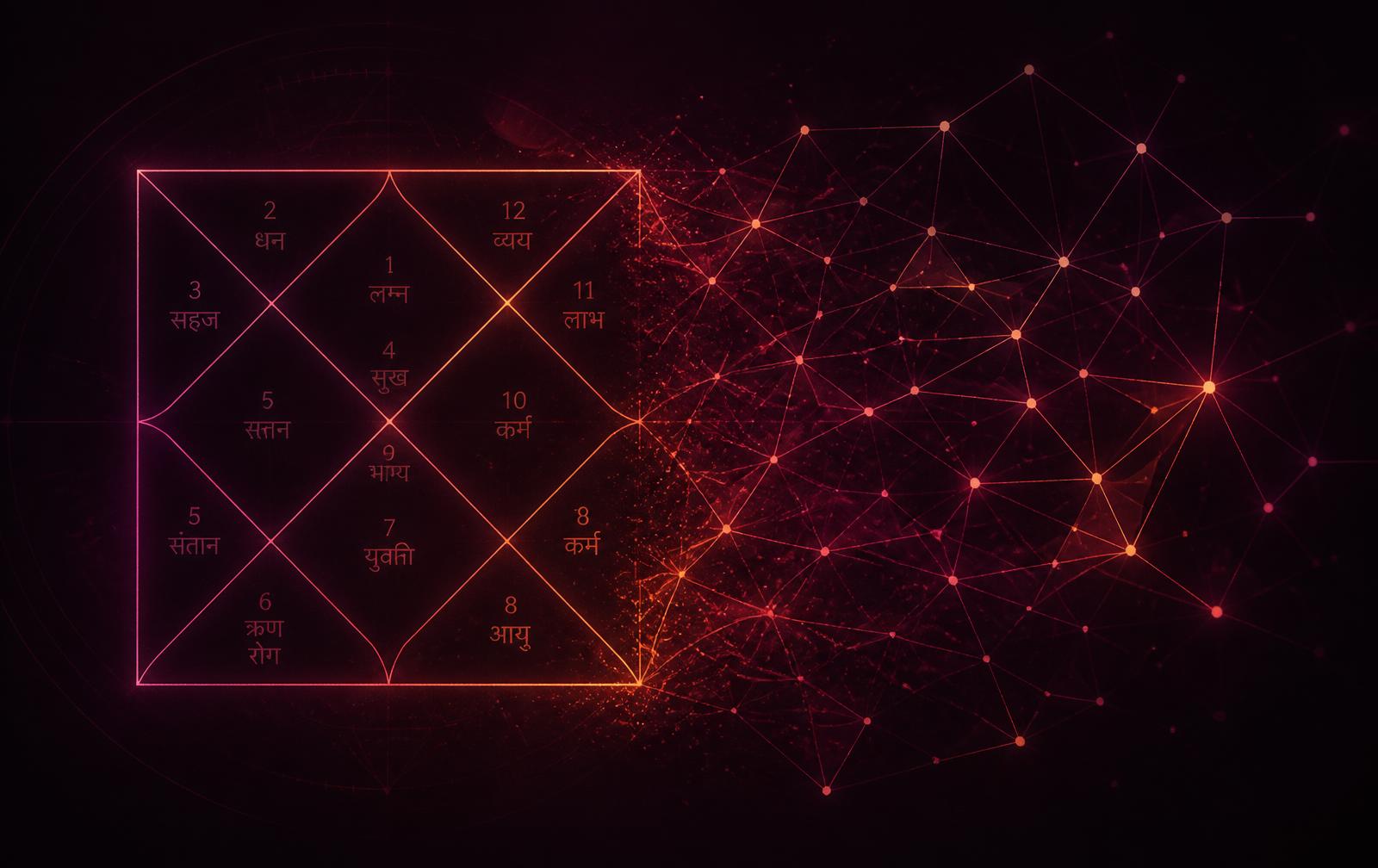
WHAT THIS IS
Veadicastro is the product people use for astrology guidance. Veadicastro Tech is where we share the startup’s engineering, AI research, product decisions and the updates shaping what comes next — openly and in detail.
AI astrology conversations, birth-chart analysis, personalised predictions, reports and live consultation with human astrologers.
Use Veadicastro →Models, engines, locked data systems, research, engineering notes, founder stories and a complete changelog of every meaningful update.
Understand how it works →SECTION 02
Veadicastro is not an AI chatbot with an astrology prompt. It is traditional astrology knowledge, structured systems, AI models, product engineering and premium UX built as one product.
A general model guessing horoscopes is not astrology. Veadicastro runs real chart computation first, then lets the model speak only about what the chart actually says.
Classical Jyotish rules are encoded as structured systems — houses, lords, yogas, dashas — instead of being paraphrased from internet text.
Caching, latency budgets, failure handling, observability and release discipline. The astrology is old; the platform is engineered like modern software.
Speed, typography, conversation flow and clarity are treated as features, not decoration.
SECTION 03
The interpretation logic inside Veadicastro did not start with a dataset. It comes from roughly three centuries of Jyotish practised and refined in our family in Pauri Garhwal — passed down through teaching, correction and thousands of real readings.
We do not publish that logic. What we can say is how it shapes the system: which factors take priority, when a placement is strong enough to speak about, how conflicting indications are resolved, and where the honest answer is silence rather than a prediction.
The lineage decides which chart factors outweigh others — the model never invents its own hierarchy.
Traditional standards for when an indication is strong enough to state, and when to stay quiet.
Encoded methods for reconciling opposing yogas, dashas and transits.
The rule base is proprietary and never exposed to the model as free text or to any third party.
SECTION 04
Veadicastro never hands raw astrology data to a language model. Every calculation passes through a locked layer that validates, filters and structures it first — the model only ever receives controlled astrology context.
Ephemeris output is checked for boundary cases — retrograde stations, house cusp edges, timezone history, ambiguous birth times.
Positions become typed context: planet, sign, house, lord, strength, active dasha, relevant transits — each with a confidence and source.
The context is sealed before it reaches the model. Nothing outside it may be used, and any claim outside it is rejected.
SECTION 05
Birth date, exact time and place — validated and normalised to a precise timestamp and coordinates.
Planetary positions, ayanamsa, houses, divisional charts, dasha periods and current transits computed deterministically.
Raw output is processed, validated and locked into a controlled astrology context — no uncontrolled data reaches the model.
The model reasons only over that structured context, following interpretation rules from our tradition.
A grounded, readable answer that can be traced back to the exact placement it came from.
SECTION 06
Vedika is our astrology reasoning model family. Different versions serve different levels of the Veadicastro experience — same locked data foundation, different depth of interpretation.
The accessible entry point. Handles core chart reading, daily and situational guidance, and clear explanations of placements for people meeting their own chart for the first time.
Deeper reasoning for serious consultations. Stronger contextual handling across long conversations, more nuanced multi-factor interpretation, and richer timing analysis.
SECTION 09
Pro conversations continue instead of resetting. Vedika 2.0 carries relevant context between sessions so your astrology conversation behaves like an ongoing consultation.
Relevant, user-approved context: your chart, recurring life themes, the questions you keep returning to and guidance already given.
Astrology consultation is continuous. Vedika 2.0 picks up where the last conversation ended instead of restarting from zero.
Memory is scoped and structured — it feeds the same locked context pipeline, never a free-form dump of past chat text.
SECTION 10
Astrology intelligence lives in the calculation core, the lineage rule base and the locked data system. Vedika's job is interpretation and communication — turning a sealed, verified astrology context into language you can actually act on. Remove the model and the astrology still exists. Remove the astrology system and the model has nothing true to say.
SECTION 11
Technology people can feel: how fast the first answer appears, how a long reading reads on a phone, how a consultation hands over without losing context. Interface quality is engineering work, and we treat it that way.
Streaming answers and warm caches so the conversation never feels like it stalled.
Typography and pacing designed for long, dense astrological explanations.
Every reading shows what it is based on, in plain language.
A dark, quiet interface that respects the subject instead of gamifying it.
SECTION 12
Backend systems, frontend development, performance, reliability, scaling, AI orchestration and data pipelines — the six systems behind every prediction.
Swiss-ephemeris grade math, ayanamsa switching, divisional charts and dasha timelines with deterministic output.
Retrieval, rule selection and prompt construction over the locked astrology context, with strict output constraints.
React and TypeScript, streaming responses, and a chat surface tuned for long readable answers on slow networks.
Globally distributed serverless functions and warm chart caches sized for Indian peak traffic.
Ephemeris data, geocoding, timezone history and evaluation datasets kept versioned and reproducible.
Latency budgets, error tracing and regression checks on every model or engine release.
SECTION 13
Experiments on AI astrology, structured knowledge, model consistency, personalization, memory and reducing unsupported interpretations.
Measuring whether the same chart and question produce the same interpretation across runs and versions.
Blind reviews that flag any claim not traceable to a placement, and the guardrails that reduced them.
How much memory improves perceived usefulness before it starts biasing readings.
Turning classical rules into machine-checkable structures without flattening their meaning.
SECTION 14 & 15
Model releases on one side, platform releases on the other. Everything that changed, dated.
Chart-grounding rewrite: responses cite the exact house, lord and dasha period behind each claim. 31% fewer generic answers in blind review.
Cross-conversation memory rolled out to Pro, with per-user controls and scoped context injection.
Pro model launched with multi-factor reasoning and long-conversation context handling.
First public Vedika model powering the free astrology conversation experience.
Lahiri/KP ayanamsa switching, D-9 and D-10 divisional charts, corrected retrograde boundary handling.
Chart computation moved to a warm edge cache. p95 first-answer latency down from 3.1s to 0.9s.
New career and compatibility reports with transit-aware timing windows and shareable summaries.
Live astrologer sessions with shared chart view and full AI conversation handoff.
SECTION 16
Every important change to Veadicastro — models, product, engineering, infrastructure and fixes — in order, starting from launch day.
SECTION 17
Founder and engineering stories: what broke, what we decided, and what we'd do differently.
The first version passed raw ephemeris output straight into the model. It invented placements. Rebuilding it as a locked, validated context layer was the single biggest quality jump we've had.
Deeper reasoning meant slower answers. Warm caches and staged streaming let us keep depth without the wait.
Every shortcut that made the model faster but the astrology shallower was reverted. The lineage sets the rules; engineering serves them.
Arpit Uniyal is an 18-year-old tech entrepreneur and software developer from Pauri Garhwal, Uttarakhand, and the founder of Veadicastro. He bootstrapped the spiritual-tech startup to a ₹1 Crore ($150,000) valuation within three months of launch, and by mid-2026 the platform was serving over 30,000 active users and around 45,000 monthly visitors.
He is bringing his family’s 300-year heritage in traditional Jyotish into the modern world through Veadicastro. By combining that lived knowledge with AI, product design and thoughtful engineering, he is building an astrology platform that makes authentic guidance more accessible, personal and understandable.
SECTION 18
We are preparing to open parts of the platform: a chart computation API, structured astrology context endpoints, SDKs and documentation for teams who want grounded astrology data instead of guesswork. Not public yet — early access is by request.
Request early accessSECTION 19
Current operational state of each system. Incidents and maintenance windows are published here and in the changelog.
SECTION 20
Most AI astrology products ask you to trust a black box. We would rather document ours: the traditional knowledge system it inherits, the locked astrology data layer, the Vedika models, the engineering behind them, the research that shapes them and every update we ship. This site is the permanent record of how Veadicastro is built — and it will keep growing with the product.